What The Mountains Remember.
If you’re ever at Mt Seymour, BC and find yourself coming up the Mystery Peak Express with a chatty old-timer, there’s a good chance they’re going to point out two things. One, the (Dave) Cashen Hip, probably the resort’s most famous spot (the “City Booter” is beyond the ropes). And two, a gully below the top of the chair, a steep descent and quick uphill that keeps the crowds out of a side-hit filled run. Regarding the former, they’ll probably tell you about someone they saw launch there once, maybe all the way back to Cashen himself if you’re lucky. For the latter, there’s only one thing worth mentioning: in the legendary winter of 1998/1999 (when nearby Mt Baker set a snowfall world record) twenty metres of snow turned that gully into a gentle slope as it filled in completely. If you’re unloading the chair now, maybe squinting through driving rain, long after the Wildcats have grown up, moved away, and started families of their own, those little facts feel like things worth remembering.
Any snowboarder who’s ever made the trip to follow a friend around their local hill knows how important it is to know your way around. They dip into the forest for a dream line and you fly-by on a boring groomer. They pick their way to a perfect landing and you find yourself standing above a perfectly flat landing. They time up their speed to snipe every transition while you case every knuckle or launch past every sweet spot. It pays to have been somewhere before.
*
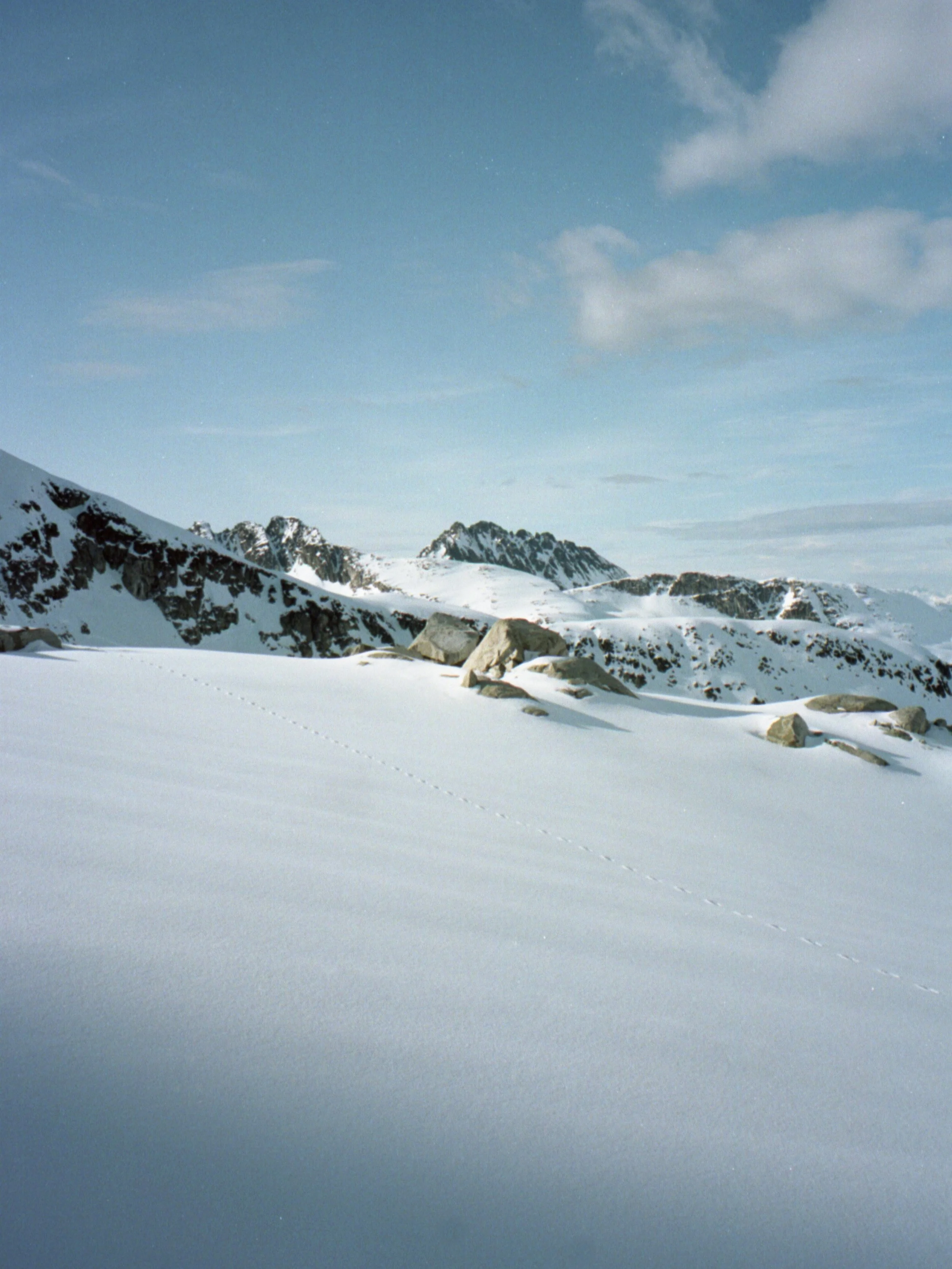
Last spring some friends and I tried to complete Whistler’s Spearhead Traverse, a 34 kilometre route that takes people out the Blackcomb backcountry and over peaks and glaciers before looping back to Whistler Mountain. We spent the first day tracing the well-worn route around and over shoulders on Blackcomb, Decker Mountain, Mount Trorey, and Mount Pattison. It was early April and the late afternoon sun gave us extra time to hike, to think, and to read in the tent after we had descended down to the Tremor Glacier. I spent less time focused on the route or my turns than running over every curve and spine and gully of all the mountains in every direction, trying to remember the times I’d seen them before.
The first time I set eyes on the Spearhead from anywhere other than a chairlift was ten years ago, in mid-August, cowboy camping next to Russet Lake, what is now generally the last night’s campsite for groups on the winter traverse. The lake was cold and fresh, full of water running off a disappearing pocket of snow on Fissle Mountain, described by some older guidebooks as a glacier. The sun glowed every shade of purple, orange, and pink as the light peeled up and off the tops of the summits of Decker, Trorey, Pattison, and Tremor Mountain. A little emergency shelter called the Himmelsbach Hut stood facing the mountains, and an outhouse with a Dutch door looked the same way, providing the most scenic spot to take a shit many people will ever see.
On the second morning this past April we opened the tent door and found no views at all, only the fog of a storm blown in a day ahead of schedule. The faintest outline of the cliffs of Tremor faded in above us. By the time we’d packed up camp, the sun had risen over some unseen ridge and the air had turned from deep blue to a flat grey. We thought about how tired we were – how tired I was, long out of shape for this sort of thing – and looked around for any sign from the mountain. Half an hour later, the storm made the decision for us. By the time we were back over the top of Pattison, the air had turned soggy, driving rain falling all the way to the summits. When we downloaded the Blackcomb gondola I was as wet as I would have been had we swam back to the resort.
After climbing back off the Tremor Glacier, we had regrouped in a little pocket between Pattison and Trorey, a hanging valley above the Trorey Glacier. As I sorrowfully gave in and started eating my celebratory chocolate bar, my friend pointed to the ridges that sheltered the spot from the wind and said “nice place for a hut.”
He wasn’t speculating. One day, maybe, that spot will be home to the third of three European-style alpine huts, a venture a local group has long hoped to develop. The first hut now sits above Russet Lake, occasionally referred to as the “Taj-Ma-Hut,” an enormous structure that interrupts the view of the surrounding slopes and meadows from untold angles and looks absolutely nothing like the old Himmelsbach, a tiny, rounded frame that was easy to miss in the sort of weather that often makes emergencies. Instead, the new hut looks like something between a ski resort’s base lodge, a new-money millionaire’s mega-cottage, and a suburban dentist’s office. It is well heated and has extra cooking gear and sleeping mats, for people who don’t feel like carrying theirs.
If all three huts are completed, life will be much simpler on the Spearhead. No more heavy tent in the pack, no more soggy mornings, no more mental calculus on what to keep warm in the bag as we sleep. Instead the traverse will be a pleasant tour, lazy climbing from mountain to mountain, three huts giving plenty of options on what to do and how far to go each day. That is, if the mountains cooperate.
When we turned around at Tremor, we hadn’t even made it to the hard part of the traverse. For most of the history of the Spearhead Traverse, dropping onto the Overlord Glacier, approaching Russet Lake on the turn back to Whistler, was something of a toss-up. Sometimes a short rappel was required. Sometimes a snowy or even rocky downclimb. In some years, people would come over the ridge and find they were ready to ride right onto the glacier. It wasn’t entirely uncommon to hear backcountry obsessives debate the possibility of forgoing bringing a rope at all, skipping roping up for glacier travel in the name of speed. But sometime about a decade ago, the mountain started making that decision too. Now, if an interested party wants to get past Overlord quickly (there is a longer way around the mountain), there’s no question of a rope. For now, almost always, the mountain presents the cliff and a rappel. Glaciers melt from both ends, so they don’t just recede but also slump at the top. Overlord, like every glacier in the Spearhead range, and like nearly every glacier on earth, has shrunk considerably. Who knows how it will look in ten or twenty years.
*
There’s a common motto for those trying to stay sane as they suffer through some horrible obstacle to get up and over the mountain and find the perfect line: “if it was easy, everyone would do it.” In the last five years, huge amounts of people have started finding their way into the backcountry. This is a good thing. The mountains should be enjoyed. But as time goes on, more and more people go into the mountains looking for the path of least resistance. People desperate to write their names in summit registries and post about the mountain they think they’ve “conquered” now beg for GPS tracks on social media, unwilling to explore on their own. Sleds, heaters, huts, proliferate, machines to pick apart the backcountry in the name of someone’s enjoyment, someone who is unwilling to find their way out there, the misery and the glory of the climb be damned.
Those who have come to know the backcountry know things are not always so simple. That there’s a difference between leaving a mark and recording history. Each fall they return to the mountains and find that not every detail is as remembered. Trees fall over beloved snake runs. Resorts cut a new line into popular glades. An enormous hut is built in a picture-perfect meadow. A new helicopter license is given out for previously foot-access only wilderness. The government flirts with selling off the public backcountry to the highest bidder. In 2019, two giant, climate-driven landslides wiped the northwest face of Joffre Peak, near Pemberton, BC, off the map. Two bucket-list lines – Twisting Couloir and Central Couloir – were gone, ridden for the last time. Some of these things can be fought. But for many, not much can be done. Besides remembering what was there before. Maybe writing it down or taking a photo. So that whoever comes next knows.